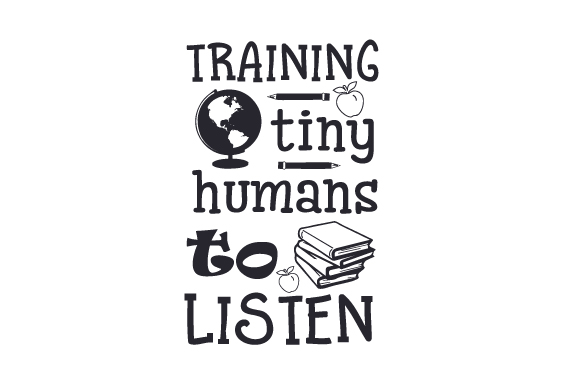
Training Tiny Humans to Listen: Crafts for School Amp
As a brand designer who has spent the last decade refining visual identities for local businesses, I approach every new graphic design asset with a critical eye. It is not enough for an illustration to be cute; it must serve a strategic purpose within a broader brand identity. Recently, I evaluated "Training Tiny Humans to Listen," a piece found under the School Amp and Crafts categories, specifically to see if it could anchor a real-world project for a boutique children's education center and handmade toy shop. My goal was to determine if this asset could transcend its digital origins to become a functional component of packaging design, product labels, and marketing visuals.
Upon first inspection, "Training Tiny Humans to Listen" exudes a mood that is undeniably playful yet grounded in a sense of gentle authority. The aesthetic suggests a brand personality that is friendly, approachable, and deeply connected to the developmental stages of early childhood. It feels handmade and organic, avoiding the sterile precision of corporate tech brands in favor of something warmer and more human. This specific vibe makes it an exceptional fit for small business branding projects involving daycare centers, parenting workshops, or artisanal toy makers who want to communicate patience and guidance. It strikes a balance between festive energy and soft, decorative charm, making it versatile enough for both modern design applications and rustic, boutique settings.
In a practical local business scenario, imagine a client launching a line of wooden educational blocks or a series of parenting guidebooks. "Training Tiny Humans to Listen" can be seamlessly integrated into logo design concepts where the text acts as a display element, drawing immediate attention. Beyond the logo, its utility expands significantly. I envision this asset working beautifully on hang tags attached to handmade clothing, serving as a whimsical header on thank-you cards included in shipment boxes, or even as a central graphic on stickers used to seal packaging. For food businesses targeting families, such as a bakery specializing in kids' birthday cakes, this design could adorn menu graphics or price lists, creating a cohesive theme that resonates with parents.
The true value of a high-quality design asset lies in its ability to elevate the entire customer experience. When applied correctly, "Training Tiny Humans to Listen" supports business presentation by creating a stronger first impression. It aids in visual hierarchy, guiding the customer's eye to the most important message on a product label or promotional ad. By maintaining a consistent visual language across social media graphics, website banners, and physical printable inserts, a brand can foster better product recognition and improved customer trust. There is a tangible sense of professional branding when a customer sees a unified aesthetic from the Instagram feed to the unboxing experience; this asset provides that connective tissue, offering better shelf appeal and a stronger emotional connection with the target audience.
Regarding specific placement, this illustration works best as a hero graphic on packaging accents or as a decorative brand element on seasonal campaign visuals. It shines on product mockups for tote bags or t-shirts, where the phrase can stand alone or interact with other typographic elements. For boutique visuals, it serves as an excellent focal point on promotional banners during back-to-school seasons or parenting awareness months. However, a seasoned designer knows that restraint is key. This asset should be used carefully in contexts requiring formal corporate branding, where its playful nature might undermine seriousness. It is also less suitable for very small product labels where fine details might get lost, or on crowded packaging layouts where it would compete with essential legal information or ingredient lists. Furthermore, it may clash with luxury minimalist brands that rely on stark simplicity rather than decorative phrasing.
From a technical execution standpoint, there are several critical notes for any designer considering this for client work. First, always test the asset on real packaging design mockups to gauge how the proportions sit on different surfaces. It is vital to check its usage in black and white to ensure legibility when color printing is not an option. Previewing the design on small labels is necessary to confirm that the typography remains crisp and readable. When integrating "Training Tiny Humans to Listen" into a broader system, test it alongside various typefaces—pairing it with a clean sans serif font for contrast, a classic serif font for elegance, or a flowing script font to enhance the handmade feel.
Since the asset is available in formats like SVG design files, Transparent PNG, EPS, and DXF, you have significant flexibility. The vector formats (SVG, EPS, DXF) are crucial for scalability, allowing you to resize the graphic for large editorial design spreads or massive web design headers without losing quality. The PNG design file is perfect for quick social media overlays, provided you review the transparency to ensure no unwanted halos appear against colored backgrounds. Before finalizing any commercial design project, always confirm the commercial license terms. Whether you are using this for a Canva template you intend to sell or for physical product sales, understanding the licensing restrictions is non-negotiable to protect your business and your clients.
Ultimately, "Training Tiny Humans to Listen" is more than just a phrase; it is a versatile tool for storytellers. When leveraged with intention, it transforms standard marketing visuals into memorable brand moments. Whether you are a handmade business owner crafting unique goods or a marketer developing a seasonal campaign, this asset offers the potential to create polished, professional, and emotionally resonant designs. By respecting its strengths and acknowledging its limitations, you can harness its charm to build a brand identity that truly listens to and connects with its audience.